
There’s a classic misconception in software development:
“If 1 developer can finish a task in 10 days, then 10 developers should finish it in 1 day.”
Sounds logical, right? Unfortunately, it rarely works that way.
Welcome to the messy, nonlinear world of software engineering, where more people ≠ faster delivery — and in many cases, it can actually slow things down.
💡 Why Scaling Dev Teams Doesn’t Work Linearly
Software development isn’t factory work. You can’t just split a task into 10 equal parts and hand it out like slices of cake. Here’s why:
Not all tasks are parallelizable: Some steps depend on others. You can’t test a feature before it’s built. You can’t write integration code until the components exist.
Communication overhead increases: With more developers, more time is spent syncing, resolving merge conflicts, reviewing each other’s code, and coordinating timelines.
Onboarding and ramp-up time: New developers don’t start at full speed. They need context, access, onboarding, and mentorship — all of which slow the team down in the short term.
Context switching and meetings: As team size grows, distractions do too.
🧠 The Formula to Estimate Team Efficiency
Instead of relying on gut feeling, use a model that accounts for how work actually gets done in a dev team.
Here’s a simple but powerful formula:
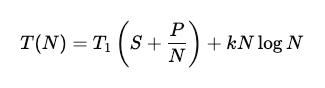
Where:

📊 Real-World Example
Let’s assume:
A task takes 10 days for 1 developer.
The task is 80% parallelizable (P = 0.8) and 20% sequential (S = 0.2).
Coordination overhead is moderate: k = 0.1
We can now estimate the time it will take with different team sizes.

At first, adding more developers helps. But then, communication costs start dominating and you get diminishing returns — or even regressions.
🧭 How to Use This in Planning
Estimate your S and P values honestly.
Backend systems? Higher S.
Independent UI components? Higher P.
Model multiple team sizes before adding people.
Ask: “Will this extra person actually make us faster, or just more chaotic?”
Look for the optimal team size.
There’s usually a sweet spot where the team is just big enough to benefit from parallel work but not so large that it drowns in coordination.
Use k as a planning lever.
Reduce k by improving processes: async updates, clear task boundaries, good tooling, CI/CD, etc.
🧵 TL;DR
More devs help, but only to a point.
Coordination cost grows faster than team size.
Use this formula:
Aim for the sweet spot, not the biggest team.
💬 Final Thought
Engineering isn’t just writing code — it’s designing how code gets written. A well-structured, lean team can often outperform a bloated one.
If you’re a tech lead or PM planning your next sprint, take a moment to ask:
“Am I speeding us up… or just adding more overhead?”